
Right now, while you read this, automated bots are scanning your business website.
They are probing for login pages, testing for SQL injection vulnerabilities, looking for unpatched software, attempting to brute-force administrator credentials, and searching for any configuration mistake that gives them a way in.
This is not targeted. It is not personal. It is automated, global, and constant — and every website on the internet receives it, from the first day it goes live.
Most UAE businesses have no protection against it beyond whatever their web hosting provider includes by default. That’s rarely enough.
A Web Application Firewall (WAF) is the layer that sits between the internet and your website or web application, inspecting every incoming request and blocking malicious traffic before it reaches your server. Not after damage is done — before.
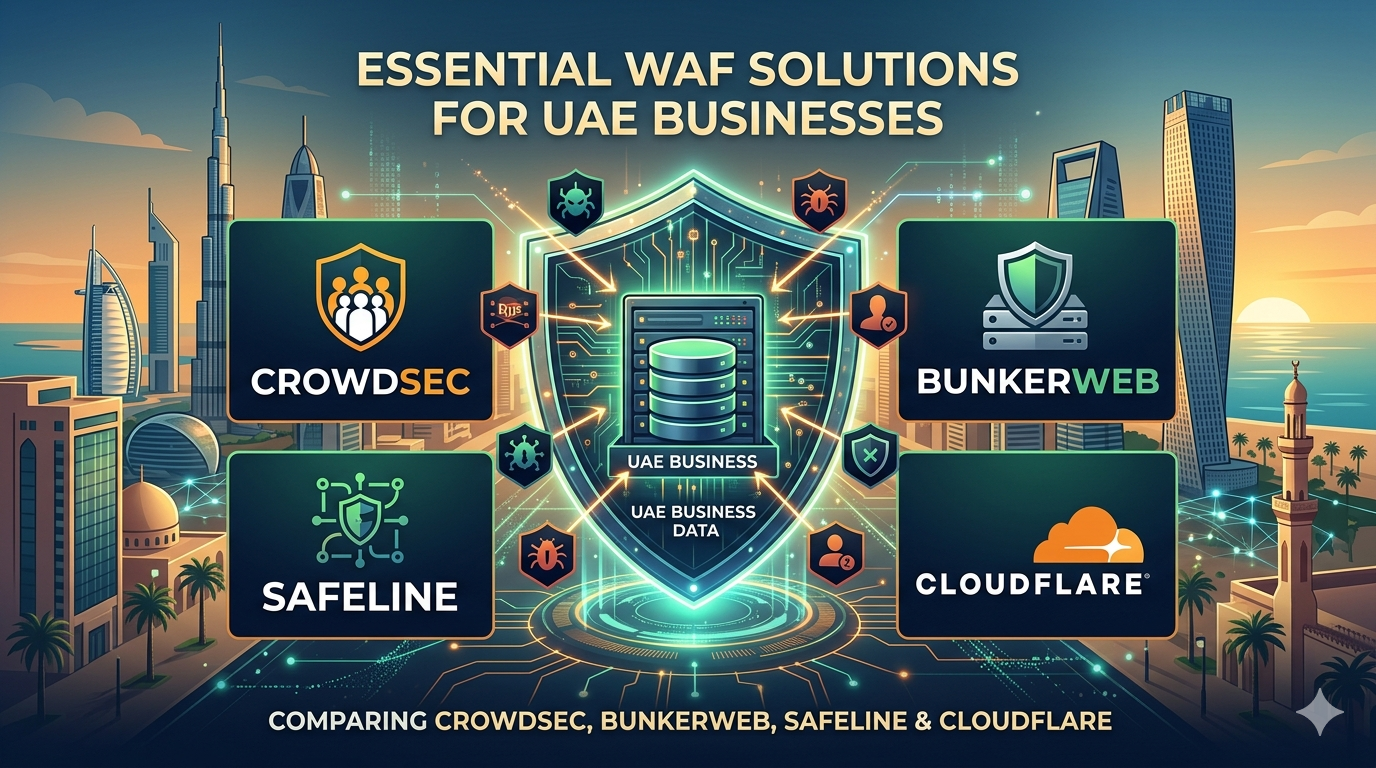
Tech Abrahams deploys WAF solutions for UAE businesses across the full range: from Cloudflare’s globally distributed edge protection, through to fully self-hosted platforms like CrowdSec, BunkerWeb, and SafeLine — running entirely on your own infrastructure with complete data sovereignty.
This post explains what a WAF does, what each solution offers, and how to choose the right one for your business.
What a WAF Actually Does — and Why Your Business Needs One
A traditional network firewall protects at the network level — it controls which ports and IP addresses can communicate with your server. It does not understand what’s happening inside a web request.
A WAF operates at the application layer. It reads and analyses the content of every HTTP and HTTPS request — the URLs, parameters, headers, cookies, and request bodies — and decides whether each request is legitimate or malicious.
This means a WAF can:
- Block SQL injection attacks — attempts to manipulate your database through crafted input fields
- Prevent cross-site scripting (XSS) — malicious scripts injected into your web pages to attack your users
- Stop directory traversal attacks — attempts to access files on your server that should never be publicly reachable
- Block bot traffic — automated scanners, credential-stuffing bots, scraping tools, and DDoS bots
- Virtually patch known vulnerabilities — block exploitation attempts against known CVEs before your software is updated
- Rate-limit abusive traffic — slow down or block sources making excessive requests
- Filter out malicious file uploads — prevent dangerous files from being submitted through your forms
For a UAE business running a website, customer portal, booking system, e-commerce platform, or any web-accessible application — these are real threats that happen at real scale every day.
The Four WAF Solutions Tech Abrahams Deploys
1. Cloudflare WAF — Edge-Level Protection for Public-Facing Websites
Cloudflare is the world’s most widely used WAF. Rather than running on your own server, it operates at Cloudflare’s global edge network — meaning malicious traffic is intercepted and blocked before it ever reaches your infrastructure.
When you point your domain’s DNS to Cloudflare, all traffic passes through Cloudflare network first. Cloudflare inspects it, applies WAF rules, absorbs DDoS attacks, caches content, and forwards only clean traffic to your origin server.
A WAF protects your web application by filtering and analyzing incoming and outgoing HTTPS traffic, detecting harmful requests and blocking them before they reach your application.
What Cloudflare WAF delivers for UAE businesses:
- Global edge network with data centres across the Middle East — low latency for UAE visitors
- Managed WAF rule sets covering OWASP Top 10 threats, updated continuously by Cloudflare’s security team
- Bot management — distinguishing legitimate bots from malicious automated traffic
- DDoS protection at massive scale — Cloudflare absorbs attacks that would overwhelm any on-premise infrastructure
- Rate limiting — control how frequently any IP or user can access specific endpoints
- Free tier with core WAF protection — sufficient for many SMB websites
- Pro and Business tiers unlock advanced WAF rules, custom rules, and bot analytics
The trade-off: All your web traffic passes through Cloudflare’s infrastructure. Cloudflare terminates TLS at their edge, meaning they can inspect the content of requests. For most public-facing websites this is entirely acceptable. For applications handling highly sensitive or confidential data where third-party inspection is a concern, a self-hosted alternative may be more appropriate.
Best for: UAE businesses with public-facing websites, e-commerce platforms, marketing sites, or web applications where DDoS protection and edge performance matter and a managed, low-maintenance solution is preferred.
2. CrowdSec — Crowd-Powered Intelligence and Behaviour-Based Detection
CrowdSec takes a fundamentally different approach to WAF. It is open source, behaviour-driven, and powered by collaboration — analysing live behaviours, not just patterns, and adapting instantly. Its detection logic is enriched by real-world signals collected from a global network of deployments.
The architecture separates two distinct functions: the Security Engine analyses your web server logs to identify suspicious behaviour patterns, and the WAF component (AppSec) acts as an inline gatekeeper, blocking malicious requests before they reach your application.
Over 200,000 installations share attack signals, creating a real-time database of malicious IPs. CrowdSec claims to block threats 7 to 60 days ahead of other vendors because of this collective intelligence layer.
What CrowdSec WAF delivers for UAE businesses:
- Crowd-sourced threat intelligence — when an IP is seen attacking CrowdSec installations globally, every other installation benefits immediately
- Classic WAF protection plus advanced behaviour detection, with full integration into the CrowdSec stack including the console and remediation components
- Virtual patching — hundreds of rules blocking exploitation attempts against known CVEs precisely, with minimal false positives
- Native integration with Nginx, Traefik, HAProxy, Apache, and Envoy — no separate appliance needed
- Runs entirely on your own infrastructure — your traffic never touches a third-party network
- Compatible with existing ModSecurity rules — businesses migrating from legacy WAF configurations can carry existing rules forward
- Free community tier with core WAF functionality and community blocklists
- Web-based management console for monitoring alerts and managing the security engine
- Works in containerised environments including Kubernetes
The data sovereignty advantage: Because CrowdSec runs on your own server, your web traffic inspection happens locally. The only external communication is sharing anonymised attack signals with the CrowdSec network and receiving updated blocklists — your actual request content never leaves your infrastructure.
Best for: UAE businesses running their own web servers or reverse proxies who want community-powered threat intelligence, behaviour-based detection, and a self-hosted solution with strong ecosystem integrations.
3. BunkerWeb — Secure by Default, Self-Hosted on NGINX
BunkerWeb is a next-generation, open source Web Application Firewall that makes web services “secure by default.” Built on NGINX, it combines the performance and flexibility of a proven web server with comprehensive WAF capabilities powered by ModSecurity and the OWASP Core Rule Set.
Where most WAF solutions are add-ons to an existing web server or reverse proxy, BunkerWeb is the reverse proxy itself — hardened, security-focused, and production-ready from the moment it is deployed. Your web services sit behind BunkerWeb, which handles all traffic inspection, filtering, and forwarding.
BunkerWeb integrates seamlessly into various environments including Linux, Docker, Swarm, Kubernetes, and Microsoft Azure. The software supports HTTPS with Let’s Encrypt automation, HTTP security headers for preventing data leaks and TLS hardening, and ModSecurity WAF integrated with the OWASP Core Rule Set for enhanced protection against common threats.
What BunkerWeb delivers for UAE businesses:
- NGINX-based reverse proxy with WAF built in — one deployment replaces your reverse proxy and adds WAF simultaneously
- ModSecurity with OWASP Core Rule Set — comprehensive protection against the most common web attack categories
- Automatic HTTPS with Let’s Encrypt — SSL certificates provisioned and renewed automatically, no manual management
- Security hardening by default — secure HTTP headers, TLS configuration, and sensible security defaults applied out of the box without additional configuration
- An intuitive web UI allows configuration without command-line expertise, while a robust plugin system enables extending functionality for specific use cases
- Plugin ecosystem — ClamAV antivirus scanning, country-based blocking, custom rule sets, and more via the official plugin repository
- BunkerWeb Cloud option — for businesses that want BunkerWeb’s protection model without managing the infrastructure, a cloud-hosted version is available
- AGPLv3 licensed — fully free and open source, no licensing cost
- Complete data sovereignty in self-hosted mode — your traffic never leaves your infrastructure
Best for: UAE businesses that want a self-hosted WAF that functions as the complete reverse proxy layer — replacing Nginx configuration complexity with a managed, security-first alternative that is straightforward to configure through a web UI.
4. SafeLine — Semantic Analysis WAF with the Lowest False Positive Rate
SafeLine is the newest of the four platforms covered here, and in many technical benchmarks it outperforms all of them on detection accuracy. Unlike traditional signature-based WAFs, SafeLine uses a patented semantic analysis engine that deeply parses HTTP traffic semantics — meaning it understands the intent of a request, not just whether it matches a known attack pattern.
SafeLine’s architecture is built around semantic traffic analysis, meaning it examines the context of requests, not just fixed patterns. This allows it to distinguish between unusual-but-legitimate traffic and genuinely malicious behaviour.
The practical result is significant: SafeLine reducing false positive rates to as low as 0.07% in user testing, compared to ModSecurity L1 at 4.58% — meaning legitimate users are almost never incorrectly blocked.
SafeLine is currently the most starred open-source Web Application Firewall on GitHub, with over 16,400 stars and is protecting over 1 million websites worldwide.
What SafeLine delivers for UAE businesses:
- Semantic analysis engine — detects zero-day and evasion-based attacks that signature-only WAFs miss
- Comprehensive attack coverage — SQL injection, XSS, OS command injection, CRLF injection, XXE, SSRF, directory traversal, and more
- Bot protection — CAPTCHA verification, dynamic defences, and anti-replay mechanisms against automated crawlers and credential-stuffing bots
- HTTP flood DDoS protection — intelligent traffic orchestration and rate limiting
- Identity and access management — unified access control for both on-premise and cloud applications
- Exceptionally low false positive rate — legitimate users are not blocked by overly aggressive rules
- Clean web UI — intuitive configuration without requiring deep technical expertise
- Simple deployment via Docker — operational in minutes from a single command
- Fully self-hosted — your traffic stays on your own infrastructure
- Free tier protects unlimited applications with unlimited rules
Best for: UAE businesses that want the most technically advanced self-hosted WAF available — particularly where false positive rate matters (e-commerce, customer portals, booking systems) or where the threat model includes sophisticated, evasion-based attacks.
Choosing the Right WAF for Your UAE Business
| Cloudflare WAF | CrowdSec | BunkerWeb | SafeLine | |
|---|---|---|---|---|
| Hosting | Cloudflare edge | Self-hosted | Self-hosted | Self-hosted |
| Detection method | Managed rules | Behaviour + crowd intelligence | ModSecurity / OWASP | Semantic analysis engine |
| Data sovereignty | No — via Cloudflare | Yes | Yes | Yes |
| DDoS protection | Excellent — global edge | Based on Server capacity | Limited | HTTP flood protection |
| Bot management | Yes — advanced | Yes — via behaviour analysis | Via plugins | Yes — built in |
| False positive rate | Low | Low | Moderate | Very low (0.07%) |
| Web UI | Yes | Yes | Yes | Yes |
| Zero-day detection | Via rule updates | Via virtual patching | Via OWASP CRS | Yes — semantic engine |
| Plugin/extensibility | Limited | Via bouncers | Plugin ecosystem | Moderate |
| Setup complexity | Very low | Moderate | Low-moderate | Very low |
| Best for | Public sites, DDoS protection | Server-side behaviour detection | Reverse proxy replacement | High-accuracy detection |
Can You Use More Than One?
Yes — and for some UAE businesses, combining solutions is the correct answer.
A common architecture Tech Abrahams deploys: Cloudflare in front for DDoS absorption and edge performance, with CrowdSec or SafeLine running on the origin server as a second line of defence. Traffic that passes Cloudflare’s edge filtering is inspected again at the origin by the self-hosted WAF — providing layered protection with both cloud-scale DDoS resilience and locally-controlled application-layer inspection.
For businesses where data sovereignty is non-negotiable but DDoS protection is still needed, BunkerWeb or SafeLine on a hardened VPS behind Cloudflare in proxy mode gives edge-level DDoS protection while keeping all request inspection on self-hosted infrastructure.
What Tech Abrahams Handles for You
A WAF that is incorrectly configured is worse than no WAF — it creates a false sense of security while either blocking legitimate traffic or allowing attacks through poorly tuned rules.
Tech Abrahams handles the complete WAF deployment for UAE businesses:
Assessment — We review your web infrastructure, application stack, traffic profile, and threat model. We recommend the right solution — or combination of solutions — for your specific situation.
Deployment — Installation and configuration of your chosen WAF platform, integrated with your existing web server, reverse proxy, or Cloudflare DNS setup.
Rule configuration — We tune the WAF ruleset to your application — enabling appropriate OWASP rules, configuring rate limiting thresholds, setting up bot management policies, and whitelist legitimate traffic patterns that might otherwise trigger false positives.
SSL and domain setup — Certificate provisioning, HTTPS enforcement, and security header configuration.
Monitoring integration — WAF alerts and logs connected to your Gotify notification setup (or other monitoring platform) so your team is notified of attack patterns in real time.
Ongoing management — Rule updates, false positive remediation, response to new CVE disclosures, and capacity adjustments as your traffic grows.
The Bottom Line
Your website is on the public internet. That means it is visible to every automated scanner, every bot network, and every opportunistic attacker on the planet — from the moment it goes live.
A WAF is not an advanced or optional security measure. It is the basic layer of protection that any web-facing business should have. The question is not whether to deploy one, but which one fits your infrastructure, your data sensitivity, and your operational model.
Cloudflare protects at the edge, effortlessly and at scale. CrowdSec brings crowd-powered intelligence to your own server. BunkerWeb makes self-hosted WAF simple and secure by default. SafeLine delivers the most technically advanced detection available in open-source form.
Tech Abrahams deploys all four — and knows which one belongs in front of your specific application.
Is your website protected against the attacks hitting it every day? Get in touch with Tech Abrahams for a WAF consultation — we’ll assess your current exposure and recommend the right protection layer for your business. No jargon, no pushy sales. Just straight advice.