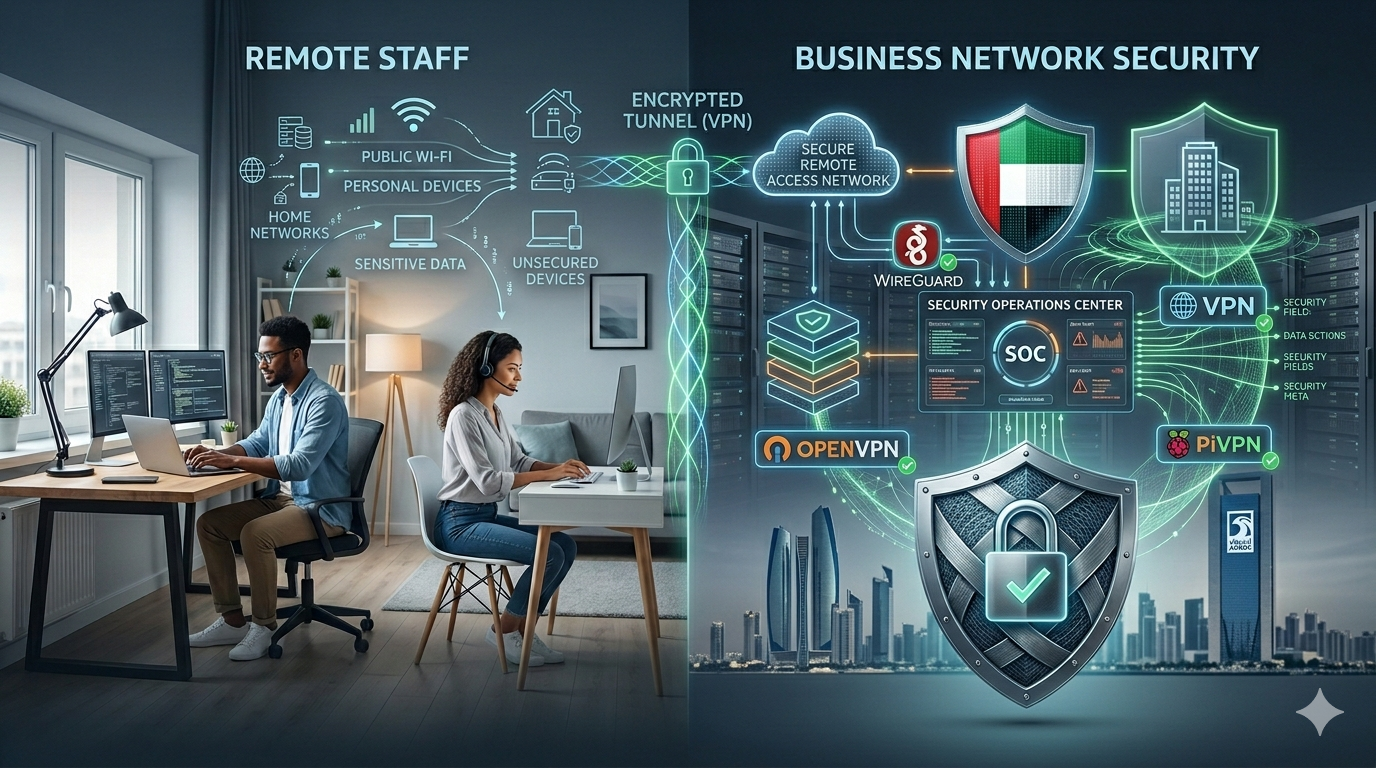

Remote work is no longer a temporary arrangement. Across the UAE, businesses now have staff working from home, from client sites, from co-working spaces, and from other countries — all of them needing access to internal business systems, shared drives, applications, and sensitive data.
Most of them are connecting over whatever internet connection is available. No encryption. No access control. No audit trail.
That’s not remote working. That’s an open door to your business.
A corporate VPN changes that. It creates an encrypted, private tunnel between your staff and your business network — so it doesn’t matter where they’re connecting from, or whose Wi-Fi they’re using. Your data stays yours.
This post breaks down the three VPN solutions Tech Abrahams deploys for businesses in the UAE, and how we make them work whether you want a physical device or a self-hosted virtual machine on your own infrastructure.
Why a Business VPN Is Different to a Consumer VPN
When most people hear “VPN” they think of services like NordVPN or ExpressVPN — apps that route your personal browsing through a foreign server to mask your location.
A corporate VPN is a completely different thing.
Instead of routing staff to a third-party server you don’t control, a business VPN routes them to your own server — on your premises, in your data centre, or on a VM you manage. Your staff connect, authenticate, and then have secure access to exactly the resources your business decides to give them. Nothing more.
This means:
- Traffic between remote staff and your office is fully encrypted
- Your ISP cannot see what your staff are accessing on internal systems
- Staff can reach business applications, internal servers, and network shares as if they were physically in the office
- You control who connects, from which devices, and what they can access
- Every connection is logged — you have a full audit trail
For businesses in the UAE handling client data, financial information, or operating in regulated industries, this isn’t optional infrastructure. It’s a basic security requirement.
The Three VPN Solutions Tech Abrahams Deploys
WireGuard — The Modern Standard
WireGuard is the newest of the three protocols and, by most technical measures, the best. It was designed from scratch to be lean, fast, and cryptographically modern.
Where older VPN protocols have codebases of hundreds of thousands of lines, WireGuard has around 4,000. Less code means fewer vulnerabilities, faster security audits, and a smaller attack surface. It uses state-of-the-art cryptography — ChaCha20, Poly1305, Curve25519 — and it simply works better on modern hardware.
Why it matters for UAE businesses:
- Fastest VPN protocol available — negligible performance overhead for staff
- Handles network switching seamlessly (moving from office Wi-Fi to 5G without dropping the VPN)
- Ideal for mobile workers whose connections change throughout the day
- Simple configuration — easier for your IT administrator to manage
- Supported natively on Windows, macOS, Linux, iOS, and Android
- Built into the Linux kernel since 5.6 — it’s not third-party software, it’s part of the OS
For most businesses deploying a new VPN today, WireGuard is the right choice unless there’s a specific reason to use something else.
OpenVPN — The Proven Enterprise Standard
OpenVPN has been the enterprise VPN standard for over two decades. It runs on virtually every platform, supports a huge range of authentication methods, and has been audited, tested, and deployed in some of the world’s most security-conscious organisations.
OpenVPN uses TLS for its control channel and supports both TCP and UDP transport. It’s highly configurable — which is both its strength and the reason it typically needs a professional to deploy correctly.
Why it matters for UAE businesses:
- Battle-tested — over 20 years of production use globally
- Supported by virtually every enterprise firewall, router, and endpoint management system
- Rich authentication options — username/password, certificates, two-factor authentication, LDAP/Active Directory integration
- TCP mode works through firewalls and restrictive networks that block other VPN protocols
- Large ecosystem of management tools and monitoring integrations
- Ideal if your business already has an Active Directory or identity management system you want to integrate with
For businesses with existing IT infrastructure — domain controllers, user directories, enterprise firewalls — OpenVPN integrates cleanly and gives you granular control over access policies.
PiVPN — Simplified Deployment on Your Own Hardware
PiVPN isn’t a separate VPN protocol — it’s an installation and management layer that sits on top of WireGuard or OpenVPN and makes deploying them dramatically easier on your own hardware.
Originally built for Raspberry Pi devices (hence the name), PiVPN runs equally well on any Debian or Ubuntu Linux system — including a virtual machine on your existing server infrastructure.
PiVPN handles the server setup, certificate generation, and user provisioning that would otherwise require significant Linux expertise. It reduces a complex multi-step deployment to a guided installation process, while still giving you full access to the underlying VPN configuration.
Why it matters for UAE businesses:
- Run a full corporate VPN on a dedicated physical device — no cloud dependency whatsoever
- Or deploy it inside a VM on your existing server — no additional hardware needed
- Staff profiles are generated as simple configuration files or QR codes — easy to distribute
- Removing a staff member’s access is instant — revoke their profile, they’re disconnected
- Complete control over your VPN infrastructure — no third-party vendor, no subscription, no data leaving your premises
- Low resource footprint — PiVPN running WireGuard on a small VM uses minimal CPU and RAM
For businesses that want VPN without cloud dependency, without subscription fees, and without their connection data touching any external service, PiVPN is the ideal deployment method.
Two Ways Tech Abrahams Deploys Your VPN
Option 1: A Dedicated Physical Device
Tech Abrahams builds and configures a purpose-built VPN device — pre-installed, pre-configured, and ready to connect to your network. You plug it in, and it works.
This approach suits businesses that:
- Want hardware they physically own and control
- Don’t have existing server infrastructure to host a VM
- Need something portable — take it between office locations
- Prefer a clean separation between the VPN server and other systems
The device runs PiVPN with WireGuard or OpenVPN underneath, depending on your requirements. We configure your staff profiles before delivery, so on day one your team can simply import their configuration and connect.
Option 2: Self-Hosted on a VM — On Your Own Premises
If your business already runs a server — a NAS, a rack server, or a virtualisation platform like Proxmox, VMware, or Hyper-V — Tech Abrahams deploys the VPN as a virtual machine on your existing infrastructure.
This approach suits businesses that:
- Already have server hardware and want to use it
- Want the VPN to run as part of their broader IT stack
- Need integration with Active Directory or other internal services
- Want centralised management alongside their other systems
We build a lightweight Linux VM, install and configure PiVPN with your chosen protocol, set up your staff accounts, configure your firewall rules and port forwarding, and test every connection before handover. The VM runs silently in the background — no maintenance required beyond occasional updates, which we can handle for you on retainer.
What About VPN and UAE Regulations?
VPN use in the UAE is a common question. The short answer for businesses is this: using a VPN to securely connect to your own company network is standard, legitimate corporate practice and is entirely consistent with how businesses operate internationally.
Corporate VPNs are used by every bank, law firm, consultancy, and multinational operating in the UAE. They protect business data and give remote staff secure access to company resources — this is exactly what they’re designed and permitted to do.
Tech Abrahams deploys VPN solutions for corporate use — connecting staff to business applications, internal servers, and company resources. We don’t deploy consumer-style solutions designed to circumvent regional content restrictions, and we advise all clients accordingly.
What Tech Abrahams Handles for You
Setting up a VPN correctly isn’t just installing software. Done wrong, it creates a false sense of security — an open port on your firewall, weak credentials, or no certificate rotation can leave your business more exposed than having no VPN at all.
Here’s what we handle end to end:
Assessment — We review your existing network, staff count, device types, and access requirements. We recommend the right protocol and deployment model for your situation.
Server setup — Physical device build or VM deployment on your infrastructure, with a hardened Linux base, firewall rules, and no unnecessary services running.
VPN configuration — Protocol installation, certificate authority setup, encryption configuration, and access policy definition.
Staff onboarding — We generate configuration profiles for each staff member and handle distribution — QR codes for mobile devices, config files for laptops.
Firewall and port configuration — We configure your router and firewall correctly so the VPN is reachable from outside without exposing unnecessary services.
Testing — We test every staff connection before handover, from multiple network types including 4G/5G and external Wi-Fi.
Documentation — You receive clear documentation on how to add new users, revoke access, and escalate issues.
Ongoing support — Software updates, certificate renewals, and new staff onboarding on retainer.
Which VPN Setup Is Right for Your Business?
| WireGuard | OpenVPN | PiVPN | |
|---|---|---|---|
| Protocol type | Modern | Proven | Deployment layer |
| Speed | Fastest | Fast | Depends on underlying protocol |
| Setup complexity | Low | High | Low |
| Mobile support | Excellent | Good | Excellent |
| On-premise | Yes | Yes | Yes |
| Cloud dependency | None | None | None |
| Best for | Speed, mobile workers | Enterprise, AD environments | Simple self-hosted deployment |
Most UAE SMBs Tech Abrahams works with land on PiVPN + WireGuard — either on a dedicated device or a small VM. It’s fast, simple to manage, fully self-hosted, and requires no ongoing subscription.
Larger businesses with Active Directory, SSO, or compliance requirements typically go with OpenVPN deployed on a VM, integrated with their existing identity infrastructure.
The Bottom Line
Your staff are accessing business systems from networks you don’t control. Without a VPN, that traffic is unencrypted, unmonitored, and unprotected. Any coffee shop Wi-Fi, hotel network, or compromised home router between your employee and your server is a potential point of interception.
A correctly deployed corporate VPN eliminates that risk. Your staff get seamless, fast, secure access to everything they need. You get full visibility, full control, and an audit trail of every connection.
The technology is proven. The deployment is straightforward for a specialist. The ongoing cost is minimal.
What’s stopping most businesses is simply not knowing it can be done this way — self-hosted, on their own hardware or VM, with no subscription and no data leaving their control.
Now you know it can.
Ready to give your team secure remote access to your business network? Get in touch with Tech Abrahams — we’ll assess your current setup and deploy the right VPN solution for your team. No jargon, no pushy sales. Just straight advice.